

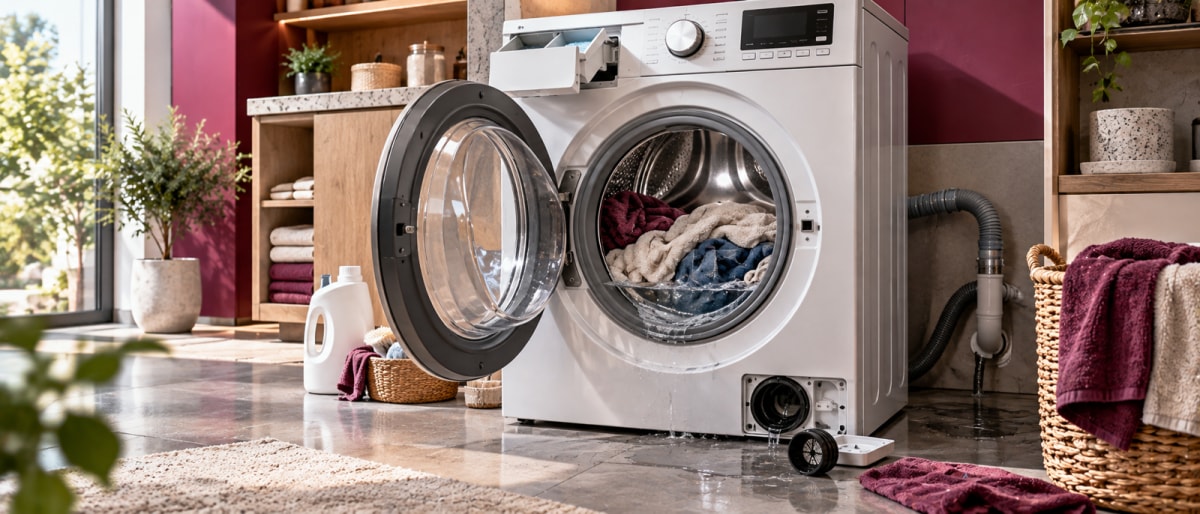
What to Do If the Washing Machine Is Leaking?
If the washing machine is leaking, it is important to identify the problem in time. Washing machines can leak for various reasons during use. Water leakage can occur from around the door, under the machine, from the detergent compartment, the water inlet hose, or the drainage system. Determining where the water is coming from makes it easier to find the cause.
In some cases, the problem is related to simple causes such as contamination of the door seal, a loose hose connection, or excessive use of detergent. In other cases, professional intervention may be required due to a damaged part or a technical malfunction.
Why is the washing machine leaking?
Why is the washing machine leaking? The answer can vary depending on where the water is leaking from and when the leak started.
The most common causes are:
contamination or damage to the door seal;
loose or damaged water inlet and drainage hoses;
clogged detergent compartment;
excessive use of detergent;
filter cap not closed properly;
dirty or incorrectly installed drain filter;
machine not leveled correctly;
overloading;
high water pressure.
Official support information from Samsung and Bosch also lists several of these as possible causes for water leakage in washing machines.
Where can a washing machine leak from?
Paying attention to the location of the leak helps to identify the problem at an early stage.
If water is coming from the door
Front-loading washing machines have a rubber seal around the door. If hair, lint, fabric residue, or other small objects get stuck in this seal, the door may not close tightly.
First, stop the machine and check the door seal. If there are foreign objects or detergent residue in the rubber part, clean them. Also, make sure the door is closed properly.
If the rubber is torn, cracked, or deformed, it is better to replace it with a suitable spare part rather than trying to repair it yourself, and consult a professional if necessary.
If water is coming from under the washing machine
Determining the source of water under the machine can be somewhat difficult. Water may come from the drain hose, the filter area, or another connection point.
First, stop the device, disconnect the power, and turn off the water supply. Then check the visible hoses and the filter cap.
If the filter cap is not closed properly after cleaning the drain filter, it can also cause water leakage. LG's official manual notes the importance of tightly closing the filter and the residual water hose cap after cleaning the filter.
If water is coming from the detergent compartment
Water leaking from the detergent drawer may be related to the accumulation of residue inside, blockage of water flow, or excessive foaming.
You need to remove the drawer and clean the detergent residue. It is also useful to check for sediment and foreign objects in the area where it is located.
Excessive use of detergent can also cause excessive foaming and, consequently, water leakage. Therefore, it is necessary to follow the amount indicated on the product packaging and the instructions for the specific washing machine.
If water is coming from the water inlet hose
The connections of the water inlet hose at the back of the washing machine may loosen over time, or the hose may be damaged.
If the machine is leaking, you can check the hose's:
connection parts;
whether it is bent;
whether there are cracks or other damage.
If there is a loose connection, it is possible to tighten it properly while the device is turned off. If there is a crack or serious damage to the hose, it is safer to replace it with a suitable hose rather than continuing to use it.
What to do first if the washing machine is leaking?
When you see a water leak, the first goal is not to repair the problem immediately, but to reduce the risk caused by water and electricity.
You can proceed in this order:
Stop the washing machine.
Safely disconnect the power supply.
Turn off the water inlet valve.
Clean up the water on the floor.
Identify where the water is coming from.
Check the visible hose, door seal, filter, and detergent compartment.
If there is a damaged part, do not use the machine.
Especially if the water has approached an electrical outlet or other electrical equipment, safety must be prioritized.
What to do if the washing machine door seal is leaking?
The door seal is one of the main parts that prevents water from escaping the drum. Therefore, the condition of the seal should be checked regularly.
If the seal is just dirty, it can be cleaned with a damp soft cloth. Hair, lint, and other residue trapped between the seal layers should also be removed.
After that, check that the door is closed properly. A piece of clothing getting stuck between the door and the seal can also cause a leak.
If the seal is torn or has lost its elasticity, cleaning will not solve the problem. In this case, replacing the appropriate part may be required.
For proper maintenance of the seal, filter, and detergent compartment, you can check the article how to clean the washing machine.
What to do if water is coming from the washing machine hose?
Hoses are among the easiest sources of water leakage to check. Both the water inlet and drain hoses should be inspected.
Bending, cracking, loose connections, or incorrect placement of the hose can cause leaks. Since the structure and placement of the drain hose vary by model, you should follow the device's manual during installation.
If there is visible damage to the hose, it is better to replace it with a suitable part rather than continuing to use it with temporary methods.
Can using too much detergent cause water leakage?
Yes, excessive detergent can cause a lot of foam. In some cases, excess foam can lead to water overflowing and leaking around the drawer and door.
Therefore, it is not correct to increase the detergent based on the principle of "if I use more, it will wash better." You should act according to the dosage on the product, the amount of laundry, and the manufacturer's instructions for the washing machine.
Can incorrect placement of the machine cause water leakage?
Placing the washing machine on an unstable or sloping surface can increase vibration. Strong movement and vibration can affect some connections and worsen the leakage problem.
The machine should stand on a firm, stable, and level surface. Proper adjustment of the feet helps maintain the stability of the device.
If strong vibration is also observed, for more detailed information about the causes, you can check the topic what to do if the washing machine is very noisy.
When should you contact a professional if the washing machine is leaking?
Some simple causes can be checked by the user. However, if the leak persists or the cause cannot be identified from visible parts, it is not correct to disassemble the device and interfere with internal parts.
It is more appropriate to contact a professional in the following cases:
if the door seal is torn;
if the hose or connection is damaged;
if water still leaks even though the filter is closed correctly;
if water is constantly coming from under the machine;
if it is suspected that water is leaking from an internal part;
if the leak continues after cleaning and simple checks.
Manufacturer's official support manuals also recommend contacting technical service if the problem is not solved by simple checks.
How to prevent the washing machine from leaking?
To reduce the risk of water leakage, it is not enough to check the device only when a problem arises. Regular maintenance is also important.
For this:
clean the door seal regularly;
do not allow residue to accumulate in the detergent compartment;
pay attention to the cleanliness of the filter;
check the water and drain hoses periodically;
do not use more detergent than necessary;
do not overload the machine;
make sure the device is placed level and stable;
clean the water remaining in the door seal after washing is finished.
Although these steps may not prevent all technical malfunctions, they can help to detect some common leakage causes in time.
Frequently asked questions about the washing machine leaking
Why is the washing machine leaking?
The most common causes include damage or contamination of the door seal, loose hose connections, incorrect closing of the drain filter, clogging of the detergent compartment, and excessive foaming.
What to do if water is coming from under the washing machine?
First, stop the device and safely disconnect the power and water connections. Then, the filter, drain hose, and visible connections can be checked. If the source of the leak is not identified, it is better not to operate the device and contact a professional.
What is the reason for water coming from the washing machine door?
Contamination of the door seal, clothing or other objects getting stuck between the seal and the door, the door not closing properly, and damage to the seal can be among the main reasons.
Can I use the washing machine if it is leaking?
If the cause of the leak has not been identified, it is not recommended to operate the device. Especially if water is approaching electrical parts, the use of the device should be stopped to ensure safety.
Conclusion
If the washing machine is leaking, first of all, it is necessary to determine where the water is coming from. The door seal, water inlet and drain hoses, filter, detergent compartment, and the placement of the device are the parts that should be checked first.
Some leaks can be resolved with simple cleaning and correct installation. However, if a part is damaged or the source of the water leak is not identified, it is a better choice to contact a professional rather than disassembling the device and interfering. Regular cleaning and proper use of the washing machine also help to reduce the risk of some problems related to leakage.
Comments0
Be the first to comment
Share your thoughts on this article