

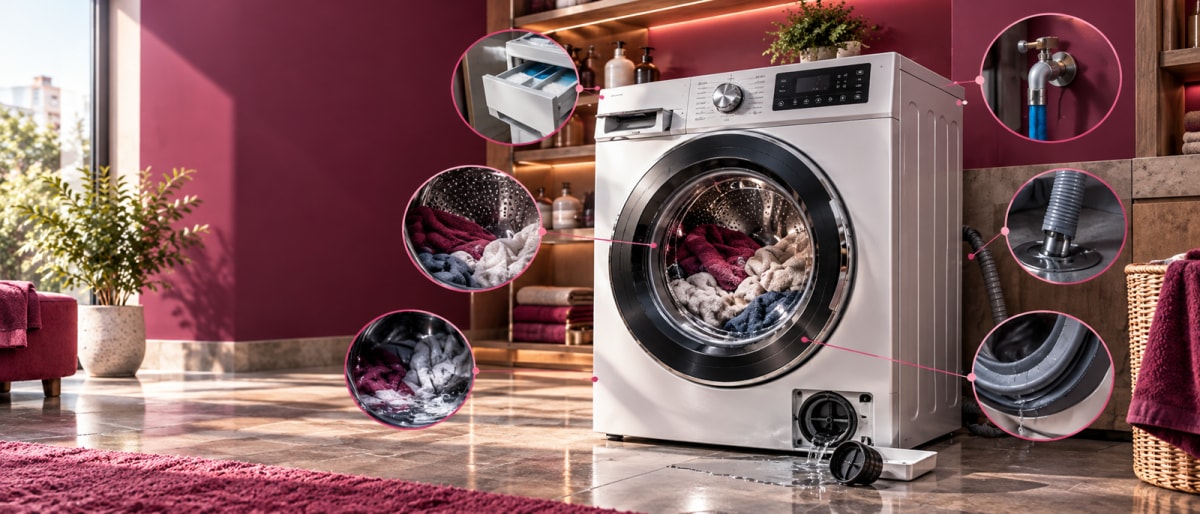
Most Common Problems in Washing Machines
Washing machine is one of the household appliances we use most in our daily lives. Therefore, it is possible to encounter various problems over time. The machine not taking in water, not draining water, the drum not spinning, and creating loud noise and vibration are among the most common situations.
Sometimes the cause of the problem is very simple. For example, the water tap may be closed, the drain hose may be bent, or too much laundry may be loaded into the drum. In other cases, the malfunction is related to the internal parts of the device and requires professional intervention.
In this article, we will talk about washing machine problems, their possible causes, and points you can check safely.
The information here is for general information purposes. When determining the cause of a specific malfunction, it is more correct to rely on the device's user manual and the manufacturer's official recommendations, and to consult a technical specialist if necessary.
Why might a washing machine cause problems?
Several factors can affect the proper operation of a washing machine. Problems with water supply, clogging of the drainage system, overloading, electrical connection, and contamination of some parts are a few of these.
When a problem occurs, you can first check the simple points. Check if the water tap is open, the electrical connection, and if there is too much laundry in the drum.
If there is no problem with these and the device still does not work properly, do not try to disassemble the internal parts yourself. Tampering with electrical and mechanical components can both further damage the device and create danger.
What to do if the washing machine does not take in water?
If the washing machine does not take in water, first check the water tap. If the tap is closed or the water pressure is not sufficient, the device will not receive water.
Then you can look at the water inlet hose. Bending or squeezing the hose can prevent water from entering the machine. The filter at the inlet can also become clogged with sediment and other particles over time.
If the problem persists after checking these, there may be a malfunction in the water inlet valve or other internal components. In this case, it is a better choice to consult a technical specialist.
What to do if the washing machine does not drain water?
If water remains in the drum after the program ends, it means the washing machine is not draining water. One of the simplest reasons for such a situation is a clogged drain filter.
Bending the drain hose or a problem in the drainage system can also prevent water from exiting. Before checking the device, it is necessary to turn it off and create safe conditions.
If the problem is not solved after checking the filter and hose, there may be a malfunction in the drain pump or other parts of the system. In this situation, it is safer to get technical help instead of disassembling the device yourself.
What is the reason if the washing machine does not spin?
If the washing machine does not spin, the reason may not always be a serious technical malfunction. Sometimes placing too much laundry in the drum or piling clothes on one side leads to a loss of balance.
If water also remains in the drum, the device may not proceed to the spin stage. Therefore, it is useful to first check that the water has been completely drained.
If the amount of laundry is normal, the water has drained, and the problem still persists, there may be a possibility of a malfunction in the belt, motor, and other mechanical and electronic parts. It is necessary to consult a specialist to check these parts.
What to check if the washing machine is leaking water?
If the washing machine is leaking water, you must first determine where the water is coming from. Leaks can occur from the water inlet hose, the drain section, the door rubber seal, or from under the device.
Loosening of hose connections and damage to the door seal are possible causes. If water is coming from under the device and it is not possible to determine the source of the leak, it is safer to stop using the machine.
For more detailed information on this topic, you can link to the “What to Do If the Washing Machine Leaks Water?” article.
Why does the washing machine make a lot of noise and vibrate?
It is normal to hear a certain level of noise during washing. Especially in the spin stage, the noise may increase due to the drum spinning faster. But if the machine is making much more noise than before and vibrating strongly, you need to check the reason.
Not placing the machine on the floor at the correct level, piling clothes on one side, and overloading can increase vibration.
If the noise is continuous and especially resembles metal friction or impact, it is better to perform a technical check rather than continuing to operate the device.
For more detailed information, you can link to the “What to Do If the Washing Machine Makes Too Much Noise?” article.
Why does the washing machine not complete the program?
Sometimes the washing machine stops at a certain stage of the program and the washing process does not finish. The time indicator may not change for a long time and the device may remain at the same stage.
The reason for this may be a problem with water not entering the machine, water not being fully drained, or water heating. Short power outages can also cause the program to stop.
If the problem recurs after checking the simple reasons, it may be necessary to check the electronic and technical parts of the device.
Why does the washing machine smell bad?
The unpleasant odor coming from the washing machine is often related to the accumulation of moisture, detergent residues, and dirt inside the device.
Keeping the door closed for a long time after washing can also create conditions for moisture to remain inside. Therefore, it is useful to keep the door open for a while after the washing program.
Regular cleaning of the filter, detergent compartment, and internal parts of the machine also helps prevent the formation of odor.
For more detailed information on cleaning the washing machine, you can link to the “How to Clean a Washing Machine?” article.
Why does the washing machine not heat the water?
If the water does not heat up as expected even though the temperature is selected in the washing program, it may indicate a certain problem.
First, check what temperature the program you selected works at. Some programs may work at low temperatures or with cold water.
If the temperature is selected correctly but the water still does not heat up, there may be a problem with the heating element, temperature sensor, or electronic control part. It is dangerous to disassemble the device yourself to interfere with these components. If the problem persists, it is more correct to have it checked by a specialist.
Why does the washing machine door not open?
The door not opening immediately after the washing program ends does not always mean a malfunction. The safety system may prevent the door from opening when there is water in the drum or the temperature is high.
First, wait for the program to finish completely and check if there is water in the drum. If the problem does not resolve, there may be a malfunction in the door lock or other components.
Do not try to force the door open. This can damage both the locking mechanism and the door rubber seal.
What to do if an error code appears on the washing machine?
In modern washing machines, a washing machine error code may appear on the screen during certain problems. The meaning of the code varies by brand and model.
These codes help to understand which system the problem might be related to. Therefore, it is useful to note the code appearing on the screen and look at its explanation in the device's user manual.
For more detailed information about various error codes, you can link to the “Washing Machine Codes and Meanings” article.
In which cases should you not interfere with the washing machine?
Some problems can be identified with a simple check. But you need to be careful in situations involving electrical and internal mechanical parts.
In the following cases, it is safer to turn off the device and get technical help:
if there is a burning smell from the machine;
if there is a problem with the electrical wire or socket;
if there is a strong water leak from under the device;
if there are unusual metal sounds from the drum;
if the machine stops continuously at different stages of the program;
if the same error code appears repeatedly;
if the device does not start at all.
It is not correct to interfere with electrical components and electronic control parts on your own. If simple checks do not yield results, it is safer to entrust the work to a specialist.
How to prevent washing machine problems?
Proper maintenance of the washing machine can help prevent many problems. For this, it is important not to overload the machine beyond the capacity indicated by the manufacturer, use the appropriate amount of detergent, and place the device on a flat surface.
It is also useful to clean the filter and detergent compartment periodically, keep the door open for a while after the washing program, and monitor the general condition of the device.
Most importantly, do not ignore small problems for a long time. For example, if the machine is making more noise than before or is not draining water as quickly as before, checking the cause in time can help prevent a more serious malfunction.
Conclusion
Washing machine problems can arise for various reasons. Not taking in water, not draining water, the drum not spinning, water leakage, loud noise and vibration, the program not completing, bad odor, and water not heating are among the most common situations.
When you encounter a problem, it is possible to perform safe and simple checks first. Checking the water tap, hoses, filter, electrical connection, and the loading of the device helps to identify the cause in some cases.
But if the problem is related to internal mechanical or electrical components, it is safer to consult a specialist rather than disassembling the device yourself. Proper use and regular maintenance can help the washing machine work more smoothly.
Comments0
Be the first to comment
Share your thoughts on this article