

What You Need to Know About Refrigerators
Refrigerator is one of the essential household appliances used to keep food products fresh for a longer period. Modern refrigerators are not limited to just cooling. Models with different volumes, sizes, cooling systems, compressor types, and additional features are designed to meet various usage needs.
When choosing a refrigerator, looking only at appearance and price is not enough. Kitchen size, number of family members, usage habits, energy consumption, and the technical specifications of the device should also be considered. This guide provides information on refrigerator types, key technical indicators, points to consider when choosing, and proper usage rules.
What is a refrigerator and how does it work?
A refrigerator is a household appliance that lowers the temperature by transferring heat from the internal chamber to the outside. For this, a compressor, cooling circuit, condenser, and other components work together.
The compressor ensures the movement of the refrigerant circulating in the cooling system. As a result of the cooling process, the temperature inside the chamber drops, creating a suitable environment for storing food products.
Modern refrigerators also use electronic control, automatic defrost, and various air circulation systems to maintain a constant temperature.
What are the types of refrigerators?
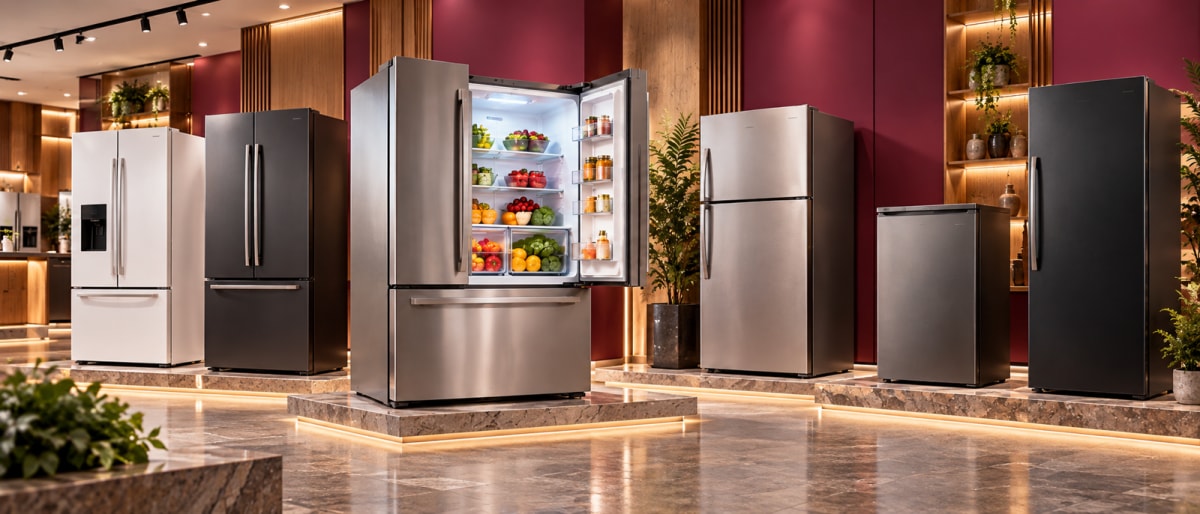
Refrigerators differ in their structure, number of doors, size, and cooling technology. The most common models are:
Single-door refrigerators
Single-door models can have a simpler structure and relatively small size. There are suitable options for small kitchens, offices, and users who store a small amount of food.
Double-door refrigerators
In double-door refrigerators, the refrigerator and freezer compartments are placed separately. This structure creates convenience for daily use, and models are offered in various sizes.
Side-by-Side refrigerators
In Side-by-Side models, the refrigerator and freezer compartments are placed vertically side-by-side. For families in need of large internal volume, this type of refrigerator can be considered. However, since their dimensions are larger than standard models, the placement area in the kitchen must be measured in advance.
Mini refrigerators
Mini refrigerators stand out with their compact sizes. They can be used for offices, bedrooms, summer houses, and small spaces. Since their internal volume is limited, they are mainly intended for storing a small amount of products.
What to look for when choosing a refrigerator?
Refrigerator selection should be made according to the user's needs. Models in the same size and price range may have different technical capabilities.
The main points to pay attention to are:
internal volume;
dimensions of the refrigerator;
cooling system;
compressor type;
energy consumption;
energy class;
temperature regulation;
volume of the freezer compartment;
structure of shelves and drawers;
noise level;
additional functions.
Each of these can affect daily ease of use and the operational characteristics of the device.
How to choose the volume of the refrigerator?
The volume of the refrigerator should be chosen according to the number of family members and the frequency of grocery shopping. For people living alone or storing a small amount of food, buying a large-volume model may not always be necessary.
In large families, there may be a need for a larger refrigerator and freezer compartment. Here, it is useful to look not only at the total liter indicator but also at the separate volume of the refrigerator and freezer chambers.
An excessively large model may take up unnecessary space in the kitchen, while a small model may not fully meet daily needs. Therefore, it is more appropriate to determine both the family's needs and the placement area before choosing.
Why are refrigerator dimensions important?
Refrigerator dimensions must be checked before buying the device. In addition to width, height, and depth indicators, the distance required for opening the door should also be considered.
Taking the measurement of the area where the refrigerator will be placed in the kitchen in advance helps to make the right choice. If the device is placed too close to the wall, furniture, and other household appliances, problems may arise regarding both ease of use and air circulation.
In addition, the dimensions of elevators, doors, and corridors should be considered when bringing the refrigerator into the apartment.
What is a No Frost refrigerator?
No Frost refrigerator refers to models that use air circulation to reduce the need for manual ice cleaning in the freezer compartment. The system helps to distribute cold air more evenly in the chamber.
No Frost technology is one of the features that increases ease of use. However, when choosing a refrigerator, instead of relying only on this function, it is necessary to look at other technical indicators of the device.
You can read detailed information about No Frost refrigerators in the blog "what is a no frost refrigerator?".
What is an inverter refrigerator?
An inverter refrigerator uses compressor technology that can operate at variable speeds. Instead of working at the same power all the time, the compressor can change its operating mode according to the cooling demand.
One of the main goals of this technology is to keep the temperature more stable and optimize the compressor's operating mode. In models equipped with an inverter compressor, energy consumption, noise level, and other indicators depend on the technical structure of the specific device.
How is refrigerator energy consumption determined?
Refrigerator energy consumption can depend on the device's model, size, energy efficiency, usage conditions, and temperature regime.
Since the refrigerator works continuously throughout the day, energy efficiency is one of the important indicators when choosing. It is possible to compare the consumption indicators of models by reviewing the information shown on the energy label.
Besides, keeping the refrigerator door open for a long time, placing hot food directly into the chamber, and operating the device in unsuitable temperature conditions can affect energy use.
What should the refrigerator temperature be?
The temperature of the refrigerator is important for keeping food products in safe and suitable conditions. In general, keeping the temperature in the refrigerator compartment around 4°C is a widely used recommendation.
In the freezer compartment, the temperature is usually kept at -18°C. It is more correct to follow the temperature regimes indicated in the manufacturer's manual of the specific model.
Lowering the temperature too much can increase energy consumption. Excessively high temperatures can have a negative effect on the storage life of some foods.
What is a refrigerator compressor?
A refrigerator compressor is one of the main components of the cooling system. It helps the refrigerant circulate within the system and plays an important role in the cooling process.
The structure and control principle of compressors can be different in various refrigerators. Therefore, when choosing a device, it is necessary to look not only at the name of the compressor but also at its energy consumption, noise level, and other technical indicators of the model.
What additional functions can be looked at when buying a refrigerator?
Modern refrigerators offer various capabilities in addition to the main cooling function. For example:
fast cooling;
fast freezing;
electronic temperature control;
various air circulation systems;
water dispenser;
ice making function;
door open warning;
child lock;
smart control capabilities.
Not all of these functions are important for every user. Therefore, it is more appropriate to choose additional capabilities according to daily usage needs.
How should a refrigerator be placed correctly?
Proper placement of the refrigerator is important for the normal operation of the device. It is not recommended to place the device very close to heat sources, such as stoves and radiators.
Air gaps determined by the manufacturer should be maintained at the back and sides. The refrigerator should be placed on a flat surface, and there should be enough space for the door to open comfortably.
Both the dimensions of the device and the general planning of the kitchen should be considered during placement.
What rules should be followed for proper use of the refrigerator?
Proper use of the refrigerator helps its daily operation to be more efficient. For this:
do not keep the door open for a long time unnecessarily;
cool hot food to a suitable temperature before placing it in the refrigerator;
place products in the chamber in a way that does not completely block air circulation;
adjust the temperature according to needs;
clean shelves and internal compartments regularly;
check the condition of door seals;
follow the usage rules indicated in the device's manual.
How is refrigerator cleaning performed?
The interior of the refrigerator should be cleaned regularly. Before cleaning, the electrical connection of the device and the manufacturer's safety instructions should be considered.
Shelves and drawers can be removed and cleaned with suitable agents. Spilled liquids and food residues on internal surfaces should not be kept for a long time.
During cleaning, hard and unsuitable agents that may damage the surface and internal components of the device should not be used.
What do refrigerator prices depend on?
Refrigerator prices can vary depending on the model's size, internal volume, cooling technology, compressor type, energy efficiency, additional functions, and other technical specifications.
It does not mean that a model with a higher price is necessary for all users. The main issue is to choose a device with technical indicators suitable for daily needs.
Therefore, when wanting to buy a refrigerator, it is a more practical approach to first determine the budget, and then compare volume, size, energy consumption, and functions within that budget.
Key points when choosing a refrigerator
In general, the following sequence can be used when choosing a refrigerator:
Measure the area where the refrigerator will be placed.
Determine the internal volume according to the family's needs.
Compare the capacity of the refrigerator and freezer compartments.
Look at the cooling system and compressor type.
Check information about energy consumption and energy class.
Consider the noise level.
Determine the necessary additional functions.
Check the model's dimensions and the door opening direction.
Review the manufacturer's usage and maintenance instructions.
Such an approach allows focusing not only on price and appearance but also on the real usage characteristics of the device during selection.
Conclusion
Refrigerators are presented with various sizes, volumes, cooling systems, and functions. Therefore, the same model cannot be considered suitable for all users. For the right choice, first of all, needs, available space in the kitchen, and the family's daily usage habits should be determined.
When choosing a refrigerator, internal volume, dimensions, compressor, cooling technology, energy consumption, temperature control, and additional functions should be evaluated together. By comparing these indicators, it becomes easier to find a model that is both suitable for daily use and meets the needs.
Comments0
Be the first to comment
Share your thoughts on this article