

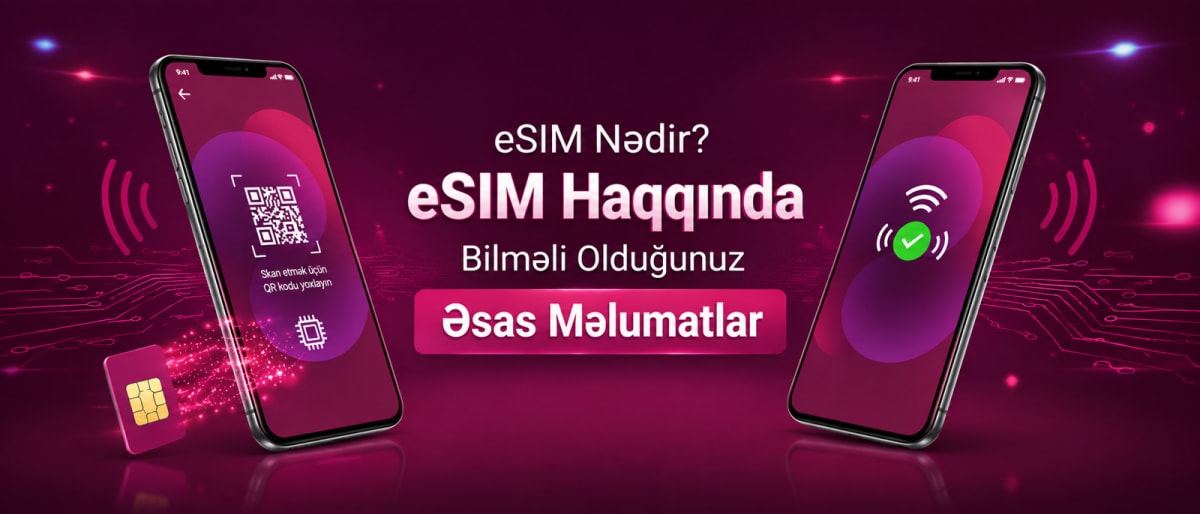
What is eSIM? Key Information You Need to Know About eSIM
What is an eSIM? An eSIM is a digital SIM technology that allows you to use mobile operator services without using a physical SIM card. This technology, located inside the phone, allows you to add a mobile operator's line profile to the device in digital form.
Just like a regular SIM card, you can make calls, send SMS, and use mobile internet with an eSIM. The main difference is that you don't need to insert a plastic SIM card into the phone for an eSIM.
eSIM is available in many modern mobile phones and is a convenient choice, especially for users who use multiple numbers, travel, or do not want to deal with a physical SIM card. However, to use an eSIM, both the phone and the mobile operator must support this technology.
What is the purpose of an eSIM?
The main function of an eSIM is to use a mobile operator line without a physical SIM card. If you have a compatible device and operator, you can use mobile communication services via eSIM just like with a regular SIM card.
With an eSIM, you can:
make and receive calls;
send and receive SMS;
use mobile internet;
activate a mobile number on the phone;
use multiple lines on compatible devices;
take advantage of an additional mobile internet plan while traveling.
Some devices also allow storing multiple eSIM profiles. However, how many lines can be active at the same time depends on the technical capabilities of the model.
For this reason, when choosing an eSIM, you should pay attention not only to the availability of the technology but also to the phone's SIM configuration.
How does an eSIM work?
An eSIM works through a digital SIM component located inside the phone. Instead of inserting a physical SIM card into the phone, an eSIM profile provided by the mobile operator is downloaded to the device.
The general process is as follows:
Mobile operator → eSIM profile → Phone → Activation → Mobile network
The operator can provide the eSIM profile via a QR code or another activation method. Once the profile is added to the phone, the device connects to the mobile network.
In other words, the main difference between an eSIM and a regular SIM card is not in the principle of how mobile services work, but in the fact that SIM data is stored on the phone as a digital profile instead of a physical card.
How to Activate an eSIM?
The answer to the question how to activate an eSIM? depends on the phone model and the mobile operator. In general, you first need to check the device's eSIM support, and then obtain the eSIM profile from the operator.
Activation is usually carried out as follows:
Check the phone's eSIM support.
Use the mobile operator's eSIM service.
Get the QR code or activation information.
Open SIM or mobile network settings on the phone.
Select the Add eSIM option.
Scan the QR code or enter the required information.
Wait for the eSIM profile to be downloaded to the phone.
Activate the mobile line.
An internet connection may be required while downloading the eSIM profile to the phone. Before activation, the device's IMEI registration and eSIM compatibility must also be checked.
How to activate eSIM on iPhone?
On compatible iPhone models, you usually use Settings → Cellular → Add eSIM to add an eSIM.
Then, the QR code provided by the operator is scanned, and the eSIM profile is added to the phone.
However, eSIM capabilities on iPhone models may vary depending on the device model and sales region. Therefore, it is especially important to check eSIM support in advance for phones purchased from abroad.
How to activate eSIM on Samsung?
On compatible Samsung Galaxy models, to activate an eSIM, you usually use:
Settings → Connections → SIM Manager → Add eSIM
section.
Then, the eSIM profile is downloaded to the phone by scanning the QR code.
eSIM support on Samsung phones may not be the same across all models and regions. Therefore, it is necessary to check the technical specifications of the specific model.
How to Transfer a Number to an eSIM?
Transferring a number to an eSIM means converting the existing number you use on a physical SIM card to an eSIM format.
In this case, the number itself usually does not change. Only the SIM format used for that mobile line changes.
It may be possible to transfer an existing number to an eSIM with operators that provide eSIM service. During the process, a new eSIM profile and activation information are provided by the operator.
Therefore, if you want to transfer your number to an eSIM, first of all, you need to check whether the operator provides this service and whether the phone you are using supports eSIM.
Which phones support eSIM?
Phones that support eSIM consist of certain models from various manufacturers. The eSIM function is available in some modern models of iPhone, Samsung Galaxy, Google Pixel, and other brands.
However, not all versions of the same model may have eSIM support. The device's region, model code, and SIM configuration can affect this feature.
When buying a phone, you should check:
eSIM support;
model code;
region version;
physical SIM and eSIM combination
You can compare models with eSIM support along with other technical specifications on TenderYard.
What are the main advantages of an eSIM?
The main advantage of an eSIM is that it does not require a physical SIM card. In addition, it offers a number of conveniences for daily use.
Does not require a physical SIM card. The mobile line is activated on the device as a digital profile.
Can create the possibility of using multiple lines. It is possible to store multiple eSIM profiles on compatible devices.
Convenient for travel. You may not need to change a physical SIM card to use a suitable eSIM internet plan abroad.
No problem of losing the card. Since an eSIM is not a physical card, there is no risk of losing or damaging a separate plastic card.
Digital activation is possible. With compatible operators, it is possible to add an eSIM profile to the phone via a QR code.
What are the disadvantages of an eSIM?
An eSIM also has some limitations.
First of all, not all mobile phone models have eSIM support. In addition, the chosen mobile operator must also support this service to use an eSIM.
When changing phones, transferring an eSIM to a new device may not be as simple as taking out a physical SIM card and inserting it into another phone. The transfer procedure depends on the operator and the device.
In addition, when buying a phone from abroad, you should pay attention to the region version. SIM capabilities may differ in versions of the same model prepared for different markets.
Is an eSIM or a physical SIM better?
eSIM and physical SIM serve the same basic purpose. The difference is in the way they are used.
Feature | eSIM | Physical SIM |
|---|---|---|
Physical card | Not required | Required |
Activation | Digital profile | SIM card |
Changing phones | Transfer or reactivation may be required | Possible to take out the card and insert it into a new phone |
Multiple lines | Depends on the device | Depends on the SIM slot |
Travel | Can be convenient with eSIM plans | New SIM may be required |
For this reason, it cannot be said that an eSIM is a more suitable choice for every user. The choice depends on the user's needs, usage habits, and the phone's technical capabilities.
How does an eSIM work in Azerbaijan?
It is possible to use eSIM services in Azerbaijan. The main focus should be on phone and mobile operator compatibility.
The user should check if their phone supports eSIM and ensure that the chosen operator provides the appropriate service.
Before using an eSIM:
phone's eSIM support;
device's region version;
operator compatibility;
tariff options;
IMEI registration
it is useful to check.
Thus, when using an eSIM in Azerbaijan, you should pay attention not only to the phone's eSIM support but also to the opportunities provided by the operator.
How does an eSIM work abroad?
An eSIM can also be useful for using mobile internet while traveling. With a compatible phone, it is possible to obtain an eSIM plan suitable for the country being visited.
In this case, you can use an internet connection without changing a physical SIM card.
It is also possible on some devices to keep the main number on one line and use a separate internet eSIM for travel. However, you should check in advance if the chosen eSIM plan works in that country.
Can an eSIM be transferred to another phone?
On some devices and operators, it is possible to transfer an eSIM to another phone. In some cases, reactivation of the eSIM profile is required for the new phone.
When changing phones, it is more appropriate to check the operator's transfer procedure before deleting the eSIM on the old device.
What happens when an eSIM is deleted?
Deleting an eSIM profile from the phone means that the profile is deactivated on the device. This is not the same as the mobile number being automatically canceled from the operator's system.
However, a QR code or other activation information may be required to reinstall the eSIM profile. Therefore, it is useful to keep this information safe.
What to do if the eSIM does not activate?
If the eSIM does not activate, first of all, you should check the phone's compatibility and internet connection.
Then:
check the correctness of the QR code;
investigate the device's region version;
check the IMEI registration;
restart the phone;
try to add the eSIM profile again.
If the problem persists, you should contact the mobile operator to check if the line and the eSIM service are active.
What to look for when buying an eSIM phone?
If eSIM support is an important feature in choosing a phone, it is not correct to choose the device based only on this indicator.
When buying a phone, along with eSIM support:
processor;
RAM;
internal memory;
screen;
camera;
battery;
charging speed;
software support
features such as these should also be taken into account.
Especially users looking for an eSIM-supporting phone should check the specific model and region version of the device in advance.
For other criteria to consider when choosing a phone, you can also look at the key points to consider when buying a mobile phone guide.
Frequently Asked Questions about eSIM
What is an eSIM?
An eSIM is a digital SIM technology used instead of a physical SIM card and located inside the phone.
What is the purpose of an eSIM?
An eSIM allows you to use call, SMS, and mobile internet services without inserting a physical SIM card.
How to activate an eSIM?
An eSIM can be activated on a compatible phone by scanning the QR code provided by the operator or using another activation method.
Is it possible to transfer a number to an eSIM?
Yes, if there is a suitable operator service, it is possible to transfer an existing physical SIM number to an eSIM format.
Which phones support eSIM?
Various iPhone, Samsung Galaxy, Google Pixel, and other brands have eSIM support in certain models. You need to check the specific model and region version.
Does eSIM work in Azerbaijan?
Yes, it is possible to use eSIM services in Azerbaijan. For this, both the phone and the operator must be compatible.
Can an eSIM be transferred to another phone?
On some devices and operators, it is possible to transfer an eSIM to another phone. In some cases, reactivation is required.
Conclusion
What is an eSIM? An eSIM is a SIM technology that performs the function of a physical SIM card in digital form. The fact that it does not require a physical card, the possibilities of using multiple lines, and its convenience while traveling make it a useful choice for modern phone users.
However, when choosing an eSIM, the compatibility of the phone and the mobile operator must be checked. Especially when choosing between phones that support eSIM, you should pay attention to the region version and technical specifications of the specific model.
You can review various models with eSIM support and available listings by looking at the mobile phones category on TenderYard.
Comments2
Afet Agayeva
09.09.2026 19:14
👍
Ramiz Valiyev
26.08.2026 08:45
Maraqlidir