

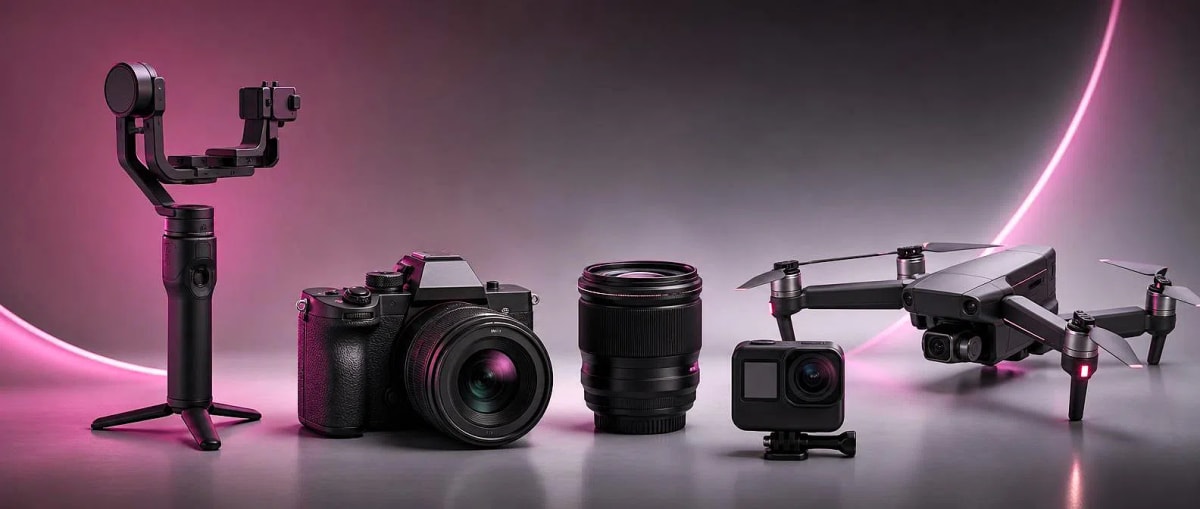
Complete Selection Guide for Photo and Video Equipment
Photo and video equipment is a broad field covering all devices and systems used for image acquisition and visual information creation in the modern era. This field is not limited to cameras and camcorders, but also includes various technologies such as lenses, drones, action cameras, camera accessories, and specialized optical devices.
In today's digital environment, these technologies have become essential tools not only for professional photographers and operators but also for social media users, content creators, engineers, doctors, and industry professionals. The reason is simple: imagery is one of the fastest and most effective forms of information transmission.
Therefore, choosing the right photo and video equipment directly affects both the quality of the result and the convenience of the workflow. However, because the selection process is often not carried out correctly, users purchase devices that do not meet their needs, resulting in problems with both performance and budget.
What needs should be identified before buying a camera?
Photo and video equipment selection is the most important stage in identifying needs correctly. Because cameras available on the market are not designed for the same purpose, and each is optimized for different usage scenarios.
If a user is creating content for social media, the main priorities here are fast operation, autofocus system, good video quality, and portability. But if the goal is advertising shoots, film production, or professional photography, different requirements arise. Here, sensor size, dynamic range, lens interchangeability, and low-light performance play a more important role.
The main mistake many users make is choosing a camera model first and then trying to use it. However, the correct approach should be the exact opposite. First, the purpose of use should be determined, and then the technical specifications suitable for that purpose should be analyzed.
This approach provides more accurate results and reduces the risk of additional costs and wrong choices in the long run.
What is the most common mistake when choosing a camera?
The most common mistake users make when buying a camera is focusing only on the megapixel count. This wrong approach has persisted for many years and has been reinforced by misinformation spread on the internet.
Megapixels only determine the size of the image, but they are not the main indicator of image quality. The factors that determine true quality are sensor size, lens quality, light-gathering capability, and the power of the image processor.
For example, a 20-megapixel camera with a large APS-C or full-frame sensor can produce better results than a 50-megapixel camera with a small sensor. The reason is that a larger sensor receives more light and creates a cleaner image.
In addition, ISO performance is also very important. To get high-quality results in low-light conditions, the camera must produce low noise at high ISO. Otherwise, image quality drops significantly.
How should a camera be chosen for vlogging?
Since vlogging and social media content have become very widespread in recent years, this area has become one of the most searched topics. When choosing a camera for vlogging, the main goal is to find a balance between convenience and quality.
In this type of shooting, the camera should focus quickly, not tire the user, and be mobile. Because vlogging is often done on the move, and the user constantly carries the camera with them.
The ability to flip the screen plays a very important role in vlogging, as the user can film comfortably while including themselves in the frame. In addition, internal microphone quality or external microphone support is also an important factor.
The most commonly used cameras in this field are mirrorless systems and action cameras. Mirrorless cameras provide higher quality, while action cameras are more portable and durable.
Why can lens selection be more important than the camera?
In photo and video equipment, more attention is often paid to the camera, but in the professional world, the lens is often considered more important than the camera itself. The reason is that the shape and quality of the image depend directly on the lens.
The same camera can produce completely different results with different lenses. The lens changes the angle, depth, focal length, and overall visual feel of the image.
Wide-angle lenses are used to show more space and are widely applied, especially in landscape, architecture, and interior photography. Telephoto lenses are ideal for zooming in on distant objects and are used in sports, nature, and reportage photography. Macro lenses are designed to show very small details by magnifying them.
If the right lens is not chosen, even the most expensive camera can produce poor results because the "character" of the image is formed by the lens.
In what cases is drone shooting more effective?
Drone technology has created a completely new perspective in the visual industry in recent years. Aerial shots, which were previously only possible with helicopters, have now become cheaper and more accessible through drones.
Drones are mainly used in advertising shoots, film production, tourism videos, and real estate presentations. In addition, they are widely applied in agriculture to analyze the condition of fields.
Modern drones feature GPS systems, automatic flight modes, object tracking functions, and stabilization technology. These features both increase safety and allow for more stable footage.
When can action cameras replace a regular camera?
Action cameras are specifically designed for shooting in extreme conditions. Their main advantages are small size, high durability, and ease of use.
These cameras are resistant to water, dust, and shock, and are therefore widely used in sports, travel, and outdoor activities. They are very effective in fields such as cycling, mountaineering, diving, and motorsports.
However, for studio-quality video production, action cameras have limited capabilities compared to a main camera. Therefore, they are mostly used as secondary cameras.
Is it possible to get high-quality results without camera accessories?
Technically, it is possible to shoot without camera accessories, but the result is often not stable or professional. Camera accessories are used to improve the quality and stability of the image.
A tripod keeps the camera's movement stable and eliminates shaking. A gimbal makes the footage smooth during moving shots. Lighting systems create a clearer and more professional image, especially in dark environments.
Without these accessories, it is very difficult to get high-quality results, especially in low-light conditions.
Which camera is more suitable for YouTube and social media?
When choosing a camera for social media, the main goal is both quality and efficiency. Because content on these platforms must be prepared quickly and updated constantly.
Mirrorless cameras are considered the most balanced choice in this field. They provide high quality for both photo and video and are convenient to use. Action cameras are more suitable for dynamic and mobile shots.
Are thermal cameras suitable for daily use?
Thermal cameras are mainly intended for industrial and technical fields. They allow for analysis by converting the heat differences of objects into images.
This technology is widely used in checking electrical systems, analyzing building insulation, and in the field of security. For daily use, it is considered a very specific device.
What problems do endoscope cameras solve?
Endoscope cameras are used to view invisible and narrow areas. Thanks to their flexible cable and small camera head, they can enter difficult places.
These devices are mainly used in car repair, inspection of industrial equipment, and diagnostics of pipe systems.
Why are devices like microscopes and telescopes included in this field?
Microscopes and telescopes are also included in the photo and video equipment category because they are based on image acquisition technology.
Microscopes show very small objects by magnifying them and are used in scientific research. Telescopes allow for the observation of distant cosmic objects.
Conclusion
Photo and video equipment is not just a means of image acquisition in the modern era, but also a technology that plays a key role in scientific, industrial, and creative fields. Making the right choice is decisive in terms of both quality and workflow efficiency.
The most important principle is this: each device should be chosen according to its purpose, and there is no general concept of "best camera", only "most suitable camera".
Comments0
Be the first to comment
Share your thoughts on this article