

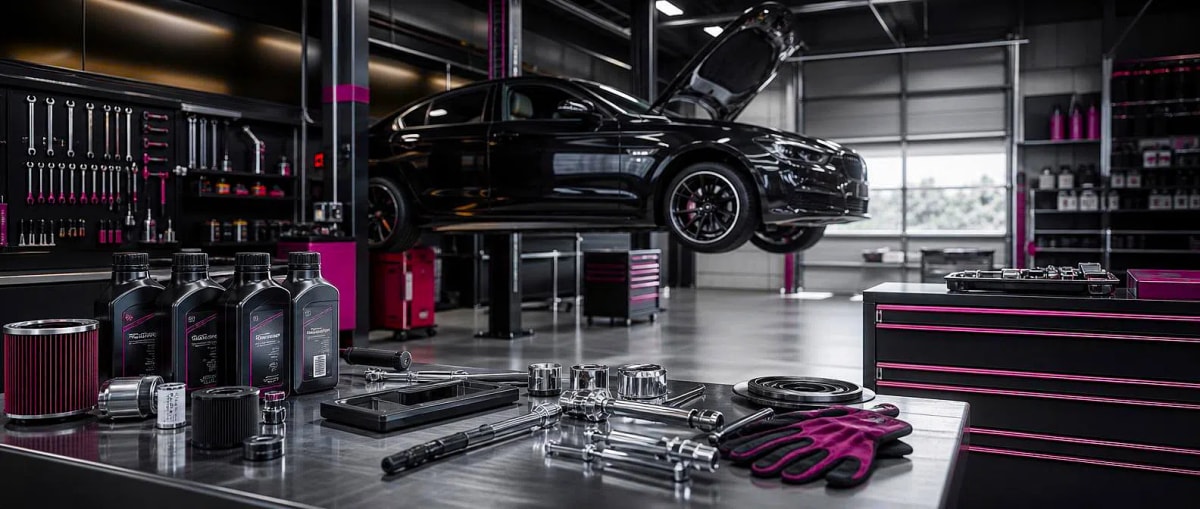
Common Mistakes People Make When Buying Auto Service Materials and Rules for Making the Right Choice
The main mistake many people make when buying auto service materials is focusing only on price or appearance instead of checking the technical quality of the product. Options that seem affordable at first glance can lead to additional problems, the need for repeated repairs, and unexpected expenses shortly after. As a result, they face repair costs again in a short time.
In fact, choosing quality auto service materials is not as difficult as you might think. You just need to know what points to pay attention to. Whether it is auto cosmetics, paint and body materials, technical sprays, filters, oils and fluids, technical belts and hoses, or sealing elements, there are important details to consider when choosing each product group.
In this article, we will discuss the most common mistakes made by car owners and mechanics, ways to identify quality products, and points to consider during purchase.
What Types of Auto Service Materials Are There?
Auto service materials refer to all products used during the maintenance, repair, and protection of a car. These materials cover a wide range, from engine health to body protection. Professional services use only certified and standard-compliant materials because low-quality materials create long-term damage while providing short-term savings.
Looking at the main categories, auto service materials are divided into the following groups.
Engine oils and lubricants are essential for the friction-free operation of every metal part inside the engine. Viscosity grade, heat resistance, and manufacturer recommendation are key factors when choosing these materials.
Brake fluids are one of the essential components of a car's braking system. Standards such as DOT 3, DOT 4, and DOT 5.1 set different requirements for different car models.
Coolants and antifreeze protect the engine from both high and low temperatures. If not chosen correctly, they can cause serious malfunctions.
Filter materials include oil, air, fuel, and cabin filters. Timely replacement prevents harmful particles from accumulating in the car.
Adhesives, sealants, and sealing materials are used in dozens of points, from engine covers to the exhaust system.
What Should You Pay Attention to When Choosing Engine Oil?
Engine oil is the most critical material for a car. Properly chosen oil protects the engine for decades, while incorrectly chosen oil can destroy it from the inside in hours. Therefore, oil selection should never be random.
There are three main types of oil on the market: mineral, semi-synthetic, and synthetic.
Mineral oil is derived from crude oil and has the oldest formula. It is the lowest in price, but it breaks down faster under heat and has a short change interval. It may be suitable for older cars, high-mileage engines, and cars operating under low loads. It should be changed every 5,000 km.
Semi-synthetic oil is a mixture of mineral and synthetic oil. It stands in the middle in terms of price and quality. It is a convenient choice for daily use and is recommended to be changed every 7,500 km.
Synthetic oil is produced in a laboratory with special formulas. It maintains its properties in both high temperatures and cold weather conditions, has a longer change interval, and protects the engine better. Although the price is high, it is more economical in the long run. It is changed every 10,000–15,000 km.
When choosing a viscosity grade, you should pay attention to markings like 5W30, 10W40, 0W20. The first part of these numbers shows the oil's fluidity in the cold, and the second part shows its fluidity in the heat. This value should be taken from the car's technical passport and not chosen arbitrarily. For example, pouring 10W40 oil into an engine that requires 0W20 accelerates engine wear.
When choosing oil, you should also look at API and ACEA standard markings. Markings like API SN, SP, ACEA C3 indicate which engine type the oil is suitable for. If these standards seem difficult to understand, simply choosing the oil recommended by the car manufacturer is the safest way.
Why Is a Car Air Filter Needed and How to Choose It?
The air filter is one of the simplest-looking but most important parts of a car. The engine requires clean air in addition to fuel to operate. Every time the engine starts, air is sucked in from the external environment, and this air may contain dust, ash, insect remains, road dust, and other harmful particles. The air filter captures these particles, ensuring that only clean air enters the engine.
A clogged or old air filter leads to a number of serious problems. Fuel consumption increases because the engine cannot get enough air. Engine power drops, which is noticeable especially during acceleration. Black smoke coming from the exhaust can also be a sign of a clogged air filter.
In response to the question of what to pay attention to when choosing an air filter, it is important to first look at size compatibility. A filter of a specific size is intended for each car, and an incompatible filter does not sit properly in the system, which can lead to dirty air passing around the filter. When choosing a filter, the car's make, model, and year of manufacture should be considered.
The quality of the filter material also plays a decisive role. Quality filters use multi-layer paper or synthetic material, capturing particles with 99% accuracy. Cheap analogs have fewer layers and lower capture efficiency. Over time, they can disintegrate, and pieces can fall into the engine, which causes very serious damage.
As for when the air filter should be changed, the general recommendation is to change it every 15,000 – 20,000 km. However, for those who travel a lot on dusty roads, this interval may be shorter. Looking at the color of the filter is the simplest inspection method. A new filter is light, white, or yellowish. When it turns black or dark gray, it is time to change it.
What Standards Should You Pay Attention to When Choosing Brake Fluid?
Brake fluid is one of the most critical safety materials of a car, but it often does not receive the necessary attention. This fluid transmits the pressure created when the brake pedal is pressed to all components of the braking system, ensuring the car stops safely. Old or low-quality brake fluid cannot transmit this pressure correctly, which directly increases the risk of an accident.
DOT standards divide brake fluids into several types. DOT 3 is the most common type, suitable for most ordinary passenger cars, and has a boiling point of 205 degrees. DOT 4 is recommended for high-performance cars, with a boiling point reaching 230 degrees. DOT 5.1 is intended for sports cars and heavy-duty conditions that require higher performance.
When choosing brake fluid, you must follow the recommendation in the car's technical documents. Pouring DOT 3 into a car that requires DOT 4 reduces braking efficiency. In addition, most brake fluids are glycol-based and absorb moisture over time. Moisture-absorbing fluid lowers the boiling point, which can cause the fluid to evaporate during heavy braking, i.e., the brake to fail completely. Therefore, it is necessary to change it every 2 years.
What Should You Consider When Choosing Coolant?
Coolant protects the engine from both high operating temperatures and freezing frost. Considering both the hot summer and cold winter of the Azerbaijani climate, this material requires special attention.
There are coolants of various colors on the market: green, red, yellow, blue. These colors are not just an aesthetic difference; they indicate the type of formula. Old-type fluids are silicate-based and usually green, and they need to be changed more often. New-type OAT and HOAT formula fluids are red, yellow, or pink and have a longer service life.
It is strictly forbidden to mix coolants of different colors. They react to form chemical sediment, clog the cooling system, and lead to serious malfunctions. When changing the system, the old fluid must be completely drained, the system washed, and then new fluid poured.
The dilution ratio is also an important issue. Pure antifreeze protects against freezing in winter, but its heat transfer efficiency is low. Therefore, coolant is usually diluted in a ratio of 50% antifreeze and 50% pure water. This mixture provides optimal protection against both freezing and overheating.
How to Distinguish Fake Auto Service Material from Original?
Fake auto service materials remain a serious problem in the Azerbaijani market. These materials are almost indistinguishable from the original in appearance, but their quality is completely different. Fake oil corrodes the engine from the inside instead of protecting it, and fake brake fluid can paralyze the stopping system at a critical moment.
To check for authenticity, you need to pay attention to several key signs.
Packaging quality is always at a high level in original products. Fonts, colors, holograms, and security elements are printed precisely. In fake products, print quality is low, colors are faded, and holograms are easily removable. Spelling errors in the text on the container are a clear sign of fakeness.
QR code and serial number verification is implemented by many manufacturers today. Brands like Castrol, Mobil, and Shell allow you to check the authenticity of the product in seconds through their websites or apps. You must take this step before purchasing.
Price indicator should raise serious suspicion. If a product is 40% or more cheaper than its official price, this can raise serious doubts about the product's authenticity. The production of quality auto service material requires a certain cost, and this cost is necessarily reflected in the price.
The appearance and smell of the product can also give a clue. Original oils have their own unique color and smell. You should stay away from products that look suspicious or have an unusual smell. If foam forms when you shake the oil container, this can also be a sign of fakeness.
Reliability of the point of sale plays a decisive role. Licensed auto spare parts stores and official service centers protect their reputation by selling original materials. We recommend paying attention to the seller's rating, user reviews, and ad details when reviewing ads for auto service materials on the Tenderyard.com platform. Sellers who provide transparent information, share real photos and videos of the product, and answer buyers' questions in detail are usually considered more reliable. The platform contains not only auto service materials but also product and service ads in various categories. Whether it is car spare parts, auto service materials, construction products, electronics, equipment, or other categories, users can easily find choices that suit their needs and compare different offers. Carefully reviewing the product's photos and videos, checking its technical specifications, and evaluating the seller's reliability helps in making a more correct decision.
What Mistakes Are Made When Buying Auto Service Materials?
The most common mistake is relying solely on price. Although cheap material reduces costs in the short term, results like engine failure, brake system problems, or leaks cost many times more.
The second most common mistake is believing in a universal product. There is no "universal" oil or coolant suitable for every car. Ignoring the manufacturer's recommendation leads to serious technical problems over time.
The third mistake is negligence regarding storage conditions. Materials stored in the open air in a garage, exposed to sunlight, or with lids not tightly closed become unusable.
The fourth mistake is delaying the change interval. Every thousand kilometers extended with the thought "it will go a little longer" damages the engine instead of protecting it.
The fifth and most common mistake is not consulting a specialist. Every car has its own unique requirements, and these requirements are written in the technical document. When in doubt, getting the advice of a professional service specialist is always the right way.
Conclusion
Auto service materials form the basis of a car's longevity and the driver's safety. Choosing the right material, adhering to change intervals on time, and shopping from reliable sources are the main principles that every car owner should follow. Investing in quality auto service materials means saving both money and time in the long run.
Comments0
Be the first to comment
Share your thoughts on this article