

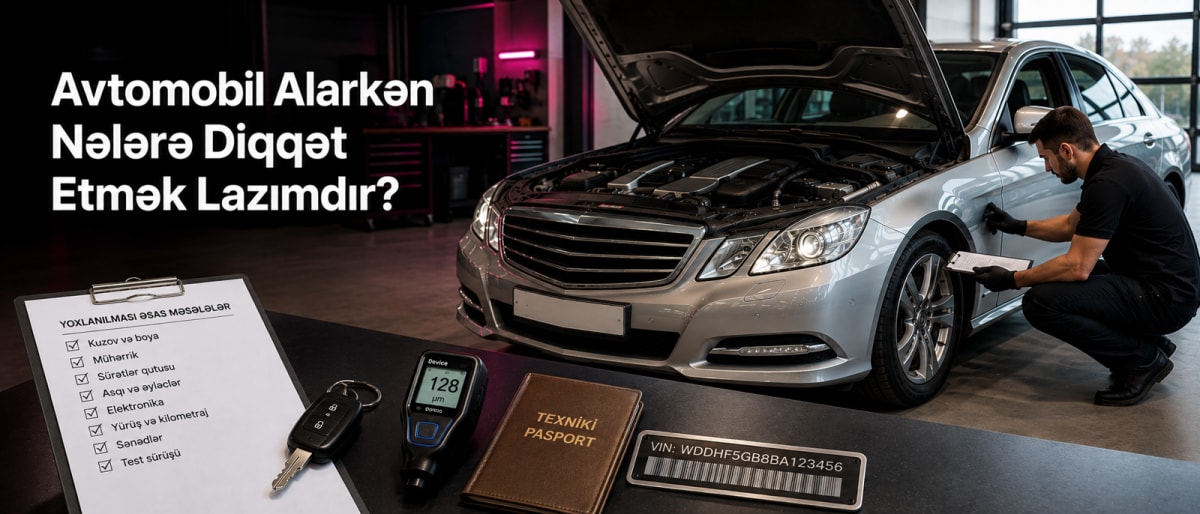
What Should You Pay Attention to When Buying a Car?
A car is a significant purchase, and making the right choice involves more than just finding a reasonable price. The vehicle's technical condition, mileage, engine, body, documents, and suitability for your intended use must be checked in advance. Especially when buying a used car, conducting detailed research helps prevent additional costs that may arise later.
Before deciding to buy a car, it is important to determine your budget, compare suitable models, and physically inspect the vehicle. In this guide, we explain what to look for when buying a car, what checks to perform, and what issues to consider before making a purchase.
Where should car selection begin?
The right car selection primarily depends on the purpose of use and your budget. If you will mainly use the car in the city, compact size and low fuel consumption may be important. When choosing a car for a family, interior and trunk volume are key, while for long trips, comfort and safety are more important.
When choosing a car, it is useful to define the following criteria in advance:
maximum budget for purchase;
fuel type and consumption;
engine and transmission;
size of the car;
safety systems;
availability of service and spare parts;
daily usage purpose.
When determining your budget, you should consider not only the purchase price of the car but also subsequent service, insurance, fuel, and spare parts costs.
What should you pay attention to when buying a car?
The answer to the question what to look for when buying a car consists of several key stages. During the first look, the car's exterior, body, interior, and general condition should be evaluated.
Next, the engine, gearbox, suspension, braking system, and electronics should be checked. For a used car, in addition to these, mileage, VIN, service history, and documents should be investigated.
Checking the car only while it is stationary is not enough. An important part of the car inspection process is the test drive. During the drive, the engine's response, transmission operation, brakes, steering, and suspension system can be evaluated more clearly.
What issues should be checked when buying a used car?
When buying a used car, the main risk is not having enough information about the car's previous use. Even if the car looks ideal from the outside, there may be hidden problems in the engine, transmission, and body.
When buying a used car, it is especially important to check the following issues:
real mileage of the car;
accident and repair history;
body and paint condition;
engine;
gearbox;
suspension and brakes;
electronic systems;
VIN information;
service history;
documents.
Comparing the information provided by the seller with other indicators allows for more accurate results.
For more specific and extensive information on this topic, you can check the article “What Should You Pay Attention to When Buying a Used Car?”.
How is the car's mileage checked?
Car mileage is one of the main indicators to pay attention to when choosing a used car. However, relying solely on the number shown on the dashboard is not correct.
Mileage should be compared with the car's general wear and service history. The condition of the steering wheel, driver's seat, pedals, and other frequently used parts can provide additional insight into the mileage.
For example, if a car showing very low mileage has excessive wear in the interior, the information needs to be verified further. Service records and existing technical documents can also help assess whether the mileage is real.
Why is it important to check the VIN?
Checking the VIN is one of the important steps when buying a used car. The VIN is a unique code that identifies the car and allows for the comparison of various information about it.
The VIN information must match the indicators in the car's documents and on the body. If possible, the car's previous accident, service, and ownership history should also be researched.
Especially for cars imported from abroad, information obtained via the VIN can help better assess the car's real past.
For details on the VIN topic, you can go to the article “What is a Car's VIN Code and How is it Checked?”.
What is checked during car diagnostics?
Car diagnostics are performed to more accurately assess the technical condition of the car. Computer diagnostics can help identify error codes stored in the car's electronic control systems.
During diagnostics, depending on the car's model and systems, the engine, transmission, ABS, safety systems, and other electronic modules can be checked.
However, computer diagnostics do not replace mechanical inspection. Parts such as engine sound, oil leaks, suspension, brakes, and body should also be evaluated physically.
For this reason, issues to check when buying a car should cover both electronic and mechanical systems.
How should the engine and gearbox be checked?
Since the engine is one of the most important components of a car, it should be carefully checked before purchase. It is necessary to pay attention to how the engine starts when cold, whether it runs stably at idle, and for unusual sounds and smoke.
Oil and other fluid leaks should also be checked. Warning lights on the dashboard related to the engine require additional diagnostics.
In the gearbox, one should look for jerks, delays, vibrations, and unusual sounds when changing gears. In an automatic transmission, it is important that the shifts are as smooth as possible.
What should you pay attention to when checking the body?
The condition of the body can provide important information about the car's past. The alignment of gaps between doors, hood, trunk, and other body elements, differences in color tones, rust, and signs of repair should be carefully checked.
When buying a used car, it is also useful to use a paint thickness gauge. This device helps determine if the paint layer is different in various parts of the body. Also, information about the car's accident and repair history should be taken into account.
If serious impact or structural repair marks are observed on the body, it is more appropriate to show the car to an independent mechanic and perform additional car diagnostics.
What details should you look at in the car interior?
The car interior can provide additional information about the intensity of the car's use and its general condition. The wear level of the driver's seat, steering wheel, pedals, door handles, and control buttons should be consistent with the car's stated mileage.
In addition, seat adjustments, seat belts, air conditioning, multimedia system, electric windows, central locking, and other functions should be checked. If there is a serious discrepancy between the condition of the interior and the mileage shown in the ad, it is useful to further investigate the car's history.
When buying a used car, you should also pay attention to whether there is moisture, unpleasant odor, water marks, or signs of hidden repairs in the interior. Such details can provide additional information about the car's previous use and possible problems.
What should you pay attention to during a test drive?
A test drive is an important part of the car inspection process. The car's real behavior is more visible when it is in motion.
During the drive:
engine acceleration;
gearbox shifts;
steering response;
braking;
suspension operation;
external noises;
whether the car moves straight
should be paid attention to.
If the car pulls to one side during braking, the steering wheel vibrates, or unusual noises occur when passing through potholes, it may require additional technical inspection.
How should car prices be compared?
When comparing car prices, choosing only the cheapest option is not the right approach. The price of the same make and model can vary depending on the year of manufacture, mileage, trim level, technical condition, and service history.
Therefore, when comparing ads for similar cars, you should look not only at the price but also at the features offered.
If a cheaper car requires subsequent engine, transmission, or body repairs, the initial price advantage may lose its significance.
What documents should be checked when buying a car?
Along with technical inspection, the accuracy of documents is also important. The car's VIN information must match the documents, and registration and ownership information should be carefully reviewed.
If there is any discrepancy or misunderstanding in the documents, refrain from making payment until the matter is fully clarified.
Especially when buying a used car, checking the legal status of the car and the accuracy of the information provided is an important part of the purchasing process.
What are the most common mistakes made when buying a car?
Although there are many issues to check when buying a car, the mistakes buyers often make are mostly similar:
making a decision based only on the exterior appearance;
automatically considering a very low price as an advantage;
blindly believing the mileage;
skipping the VIN check;
not doing a test drive;
not performing car diagnostics;
not checking documents in detail;
not considering service and spare parts costs.
Instead of making a hasty decision, checking the car in stages is a safer choice.
How can those who want to buy a car make a better choice?
Dividing the car buying process into several stages makes it easier to make a decision. First, determine your budget and purpose of use. Then, compare suitable models and car prices.
When a used option is chosen, check the mileage, VIN, body, engine, transmission, and documents. In the next stage, take a test drive and, if possible, perform car diagnostics.
This sequence helps both car selection and the purchase decision to be more well-founded.
Conclusion
The answer to the question what to look for when buying a car is not limited to just a few technical indicators. For the right choice, budget, purpose of use, car mileage, technical condition, engine, transmission, body, documents, and history should be evaluated together.
Especially when buying a used car, it is important to check the VIN, conduct a test drive, and perform car diagnostics. Instead of choosing the cheapest option, it is more appropriate to identify a car that has a balance between price and real condition.
You can research options that suit your budget and needs by comparing various car ads on Tenderyard. The main goal is not just to find a car, but to choose the right car from a technical and financial perspective.
Comments0
Be the first to comment
Share your thoughts on this article