

Operating Mechanism of Audio Systems and Modern Areas of Application
The operating mechanism of audio systems is based on the principles of sound reception, processing, amplification, and output transmission. As a result of the development of modern technologies, these systems are not limited to just transmitting sound, but also enhance its quality, providing a clearer, more balanced, and realistic audio experience.
Sound waves are first received by a microphone or sound source and converted into an electrical signal. Then, this signal is processed by audio processors, where sound frequencies are adjusted, background noise is reduced, and the overall balance is optimized. In the next stage, the signal is sent to an amplifier device, where its power is increased to a level suitable for speakers. In the final stage, this amplified signal is converted back into sound waves through speakers and delivered to the user in an audible form.
Digital Signal Processing (DSP) technologies are widely used in modern audio systems. This technology allows for real-time analysis and automatic optimization of sound. As a result, the user gets a cleaner, deeper, and more detailed sound experience.
Audio systems have expanded significantly in recent years. These systems are used not only for listening to music and watching movies at home but also extensively in educational institutions, conference halls, live events, radio and television broadcasting, studio recordings, and large stage performances. Even modern industrial and security systems actively use audio technologies.
For this reason, audio systems are no longer just a means of entertainment, but have become a core part of information transmission and communication processes. The structure and operating principle of each system vary according to its intended use, and these differences further increase the flexible and broad application possibilities of audio technologies.
How do audio systems work and what stages does sound go through?
The basic operating principle of audio systems is built on the reception, processing, amplification, and output transmission of a sound signal. This process consists of several sequential stages, and each stage directly affects the final sound quality.
In the first stage, the sound signal is received from various sources such as a TV, phone, computer, or microphone. Then, this signal is sent to a processing module where technical filtration is performed. At this stage, unnecessary frequencies are removed from the sound, balancing is performed, and the overall tone is stabilized.
In the next stage, an amplifier increases the signal to a level where the speakers can operate. In the final stage, the speakers convert this electrical signal into physical sound waves and present it to the user.
The quality of this system depends on several important factors:
accuracy and speed of signal processing
quality and distortion level of the amplifier
material and structure of the speakers
acoustic characteristics of the space used
connection and signal transmission technology
Each of these factors plays a decisive role in shaping the overall sound experience.
What are soundbar systems and why are they so widely used?
Soundbar systems are a modern audio solution with a compact design that creates a multi-channel sound experience within a single enclosure. The main purpose of these devices is to make the weak sound of internal TV speakers stronger, clearer, and more balanced.
Traditional TV speakers cannot transmit a wide frequency range due to physical limitations. Especially low frequencies (bass) are weak, and the sound feels "hollow". A soundbar overcomes this problem thanks to its larger enclosure and numerous speaker elements.
Modern soundbar models are not limited to just sound amplification. They apply Digital Signal Processing (DSP) technology, which analyzes the sound to create a virtual surround sound effect. As a result, the user gets a cinema effect without setting up an additional complex speaker system.
Soundbar systems are mainly ideal for small and medium-sized rooms because they are simple to install and do not require an additional complex cable system.
How do home theater systems work and why do they create a more realistic sound experience?
Home theater systems are complex sound systems built on a multi-channel audio architecture. The main goal of these systems is to give the user the feeling of "sound within space".
In this system, sound is divided among different speakers, and each emits sound from a different direction. For example:
front speakers transmit the main sound
center speaker clarifies dialogues
rear speakers provide atmosphere and effect sounds
Thanks to this division, the user perceives the sound as if it is coming from the environment, not from a single point.
The effectiveness of home theater systems depends not only on the quality of the devices but also on their correct placement. Incorrect placement of speakers can disrupt the sound balance, resulting in lower acoustic quality. Therefore, the size of the room, wall materials, and listening position are of great importance.
What are voice recorders used for and how do they work?
Voice recorders are portable audio devices designed for high-precision sound recording. Their main purpose is to record human voice and ambient sounds as clearly, accurately, and in a format that can be analyzed later. These devices usually consist of a special microphone system, an analog-to-digital converter (ADC), and an internal memory module.
Although the operating principle of voice recorders seems quite simple, it consists of several stages from a technical perspective. In the first stage, sound is received via a microphone and converted into an electrical signal. Then, this signal is converted into a digital format by an analog-to-digital converter and saved as a file in the memory block. Modern models also have additional sound processing algorithms, which reduce background noise and ensure clearer speech recording.
Compared to phones, the main advantage of voice recorders is that they focus solely on sound recording. Since smartphones are multifunctional, sound quality may be secondary, but because voice recorders are optimized purely for audio recording, they provide more stable and cleaner results. Furthermore, they are more effective in terms of memory management and battery life for long-term recordings.
Voice recorders are most commonly used in journalism for recording interviews, in the legal field for documenting meetings and testimonies, in education for recording lectures, and in the business environment for protocolling meetings. These devices are also considered very practical solutions for taking quick notes and creating a database of information for later analysis.
Why are sound amplifiers important and how do they work?
Sound amplifiers are electronic devices that receive a weak audio signal and bring it to a stronger level that can be heard by speakers. Their main function is not just to increase the volume, but also to process the signal correctly while maintaining its quality.
The operating principle of a sound amplifier is based on receiving the signal from the input, processing it through internal amplifier circuits, and transmitting it to the output at a higher power. During this process, the device increases the amplitude of the signal, but high-quality amplifiers do not create distortion in the sound while doing so. On the contrary, they maintain the natural balance and clarity of the sound.
In low-quality amplifiers, when the signal is excessively increased, the sound becomes blurred, distortion occurs, and as a result, the listening experience worsens. Therefore, the choice of amplifier in audio systems is one of the most important factors directly affecting sound quality.
Sound amplifiers are widely used in various fields. They are mainly found in the following places:
concert and live stage performances
conference and seminar halls
outdoor events and mass gatherings
studio recordings and radio broadcasting systems
home audio systems and home theaters
For each area of use, the power, number of channels, and technical specifications of the amplifier vary. While low-power models are sufficient for small rooms, systems with high wattage are required for large spaces.
Conclusion
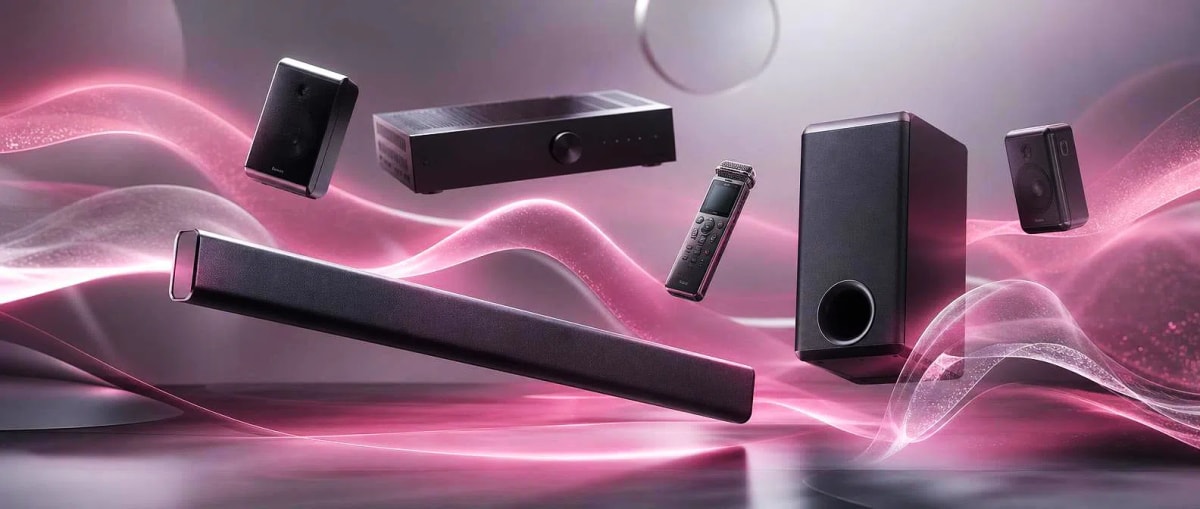
Audio systems are one of the most important directions of modern technology and are widely applied in professional fields alongside daily life. Soundbar systems offer a simple and compact solution, home theaters create a more realistic and multi-channel sound experience, voice recorders ensure accurate sound recording, and sound amplifiers make effective sound transmission possible in large spaces.
The choice of the right audio system should not be based solely on the power of the device. The main factors are the purpose of use, the characteristics of the space, and technical needs. Because in audio technology, it is not the most powerful device, but the most suitable system that gives a higher result.
Comments0
Be the first to comment
Share your thoughts on this article